
Overview
E-TRAN Plus for PSCAD is an add-on to E-TRAN and is sold/licensed separately from E-TRAN.
This module was developed internally by Electranix and the E-TRAN team from a need to develop increasingly large and complex electromagnetic transients (EMT) models for detailed studies. These study models often include many electronic-based simulation models (such as wind powerplant models) or very large study areas which all introduce challenges such as slow simulations and compiler compatibility issues between various models
We can overcome these problems by utilizing parallel processing capabilities of the “E-TRAN Plus for PSCAD”
Please contact e-tran@electranix.com for more information.

Parallelization of models.
Includes a supplementary set of E-TRAN models which allow large PSCAD cases to be broken up and run using parallel processing on multiple cores (on 1 computer) or on multiple computers.
Flexible Case Splitting
Allows a large PSCAD case to be broken up into many PSCAD cases such that:
- Each subsystem/process can run with a different simulation time step.
- Each subsystem/process can be built with a different version of PSCAD.
- Each subsystem/process can be built with a different version of Fortran compilers.
Faster Simulations
Power electronic models are inherently slow due to switching of IGBT/diode models. The simulation time step requirements of some models can also be very small compared to the step required for system modeling. Splitting the system model from power electronic models can greatly increase simulation speeds.
A large PSCAD case can be broken up electrically in the following ways:
- Where any Bergeron traveling wave transmission line or cable is used.
- At any transformer location (using the scaling transformer model)
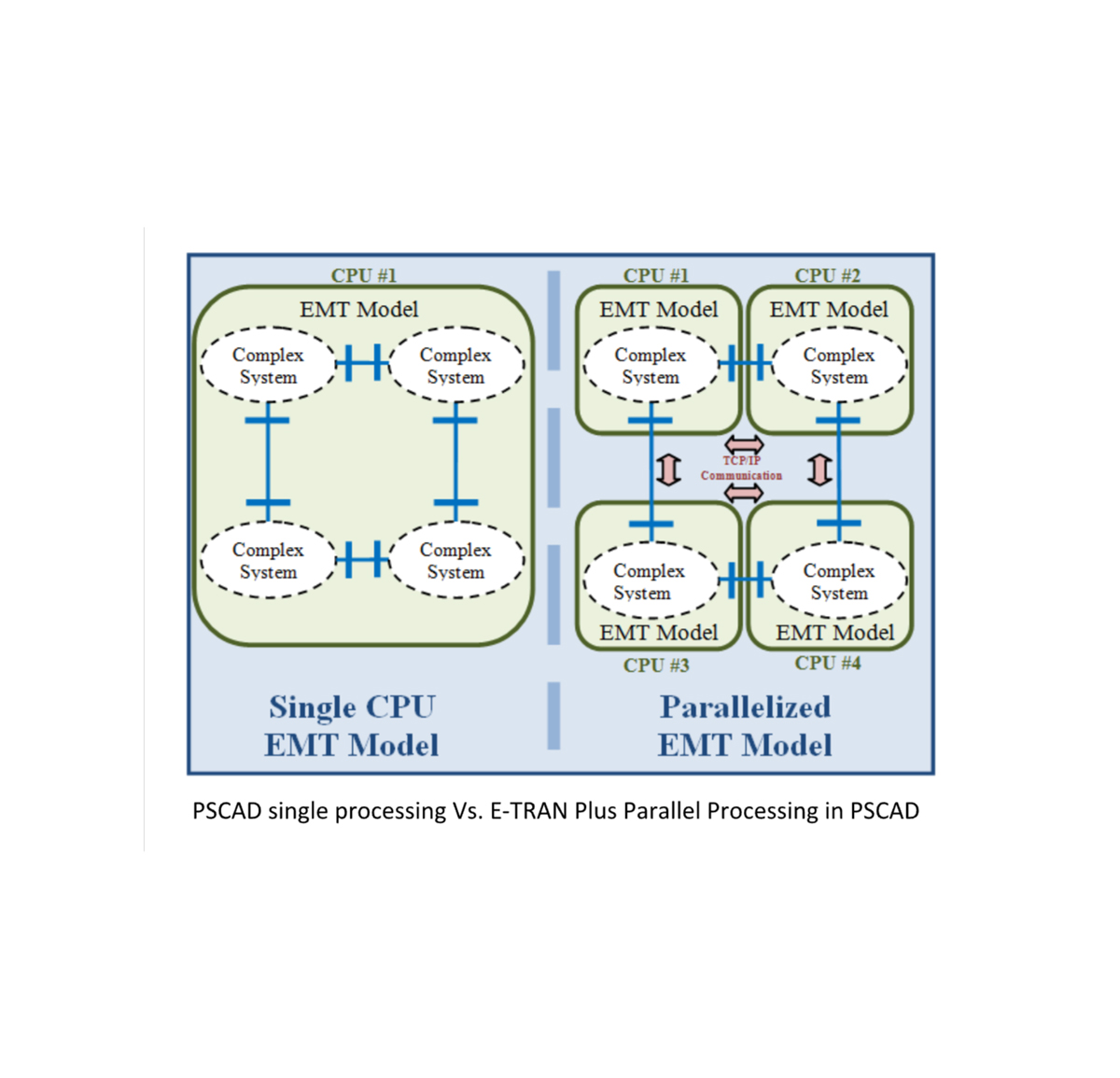
Each side of the electrical connection can be placed in its own compiled PSCAD case, and allows placing each inverter-based DER onto its own CPU/CORE (either on one computer or on other computers connected to the LAN). “E-TRAN Plus for PSCAD” therefore unlocks parallel processing capabilities as
shown in the following Figure.
Frequently Asked Questions
Yes, the cases that are communicating can be compiled by different PSCAD programs i.e. a case compiled in PSCAD V4 and PSCAD V5.
Get Software Today
For all software quotes contact us today at e-tran@electranix.com
Free Trial
A trial of our suite of software tools are available to try free of charge, if you’d like to request a free trial, please contact e-tran@electeanix.com.
Releases
All minor releases and patches will be available for E-TRAN users holding a software license. Future major releases of E-TRAN will be available at a discounted price to current users.
License Manager
Our software use the Electranix License Manager, which can administer licenses across your network for E-TRAN,E-TRAN Plus and E-SCREEN
Discounts
Discounts may be available for any additional licenses held by the same organization.
E-TRAN for PSS/E users
Electranix has partnered with Siemens/PTI to offer E-TRAN technology integrated with the PSS®E platform. E-Tran (PSS®E-PSCAD Data Conversion Module) and E-Tran Plus for PSS/E (PSS®E-PSCAD Co-Simulation) trial licenses and quotations may be requested through the following form on PSS®E site.